

How to Choose the Right I Beam Trolley for Overhead Crane Systems in Malaysia
March 12, 2026
What Is a Festoon System in Crane Applications?
April 5, 2026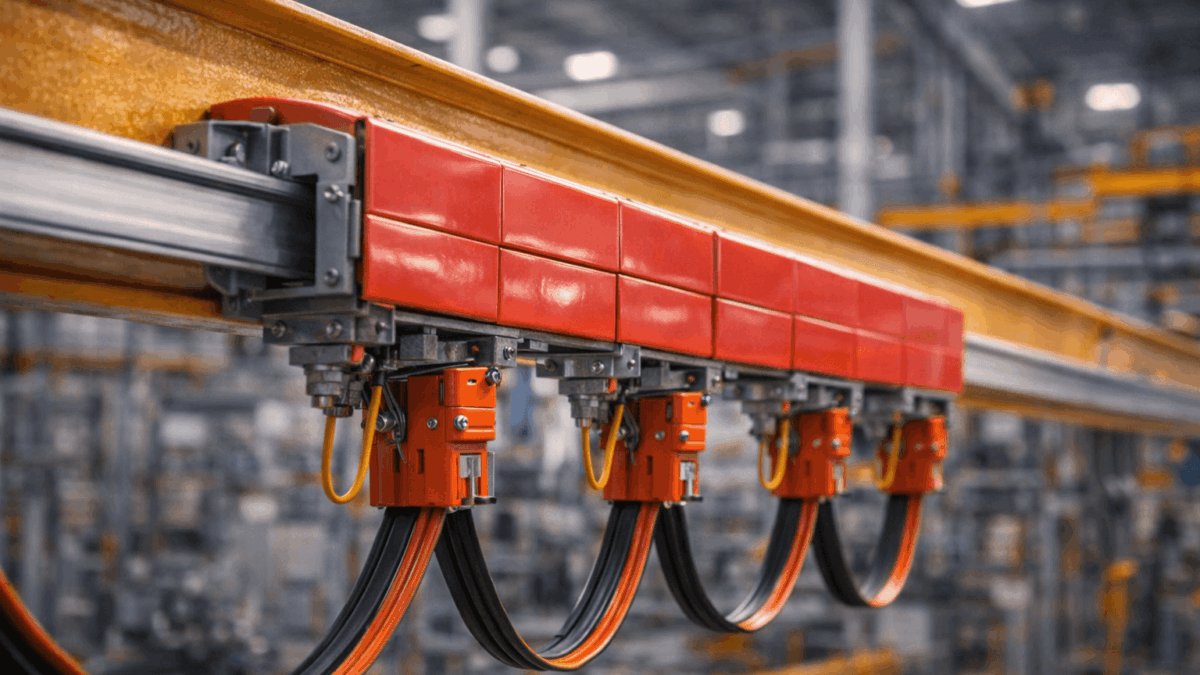
What Is a Festoon System?
A festoon system is an industrial cable management system used to supply power and control signals to moving equipment. It allows cables or hoses to travel smoothly along a track as machinery moves back and forth.
Festoon systems are commonly installed on:
- Overhead cranes
- Gantry cranes
- Hoists
- Transfer cars
- Automated material handling systems
Instead of allowing cables to hang freely or drag along the ground, the system organizes them using trolleys that run along a track, creating a controlled loop that moves with the equipment.
This improves safety, cable lifespan, and operational reliability.
Main Components of a Festoon System
A typical festoon system includes several key components working together.
1. Track or Beam
The track provides the path along which the trolleys travel.
This may be an I-beam, C-rail, or square rail, depending on the design.
2. Cable Trolleys
Trolleys support and carry the cables.
They roll along the track as the crane or moving equipment travels.
3. Flat or Round Cables
The cables deliver electrical power and control signals to the moving machine.
Special festoon cables are designed to withstand repeated bending.
4. End Clamps and Tow Trolley
These components guide the movement of the entire cable loop and ensure smooth operation.
How a Festoon System Works
The system operates through a simple mechanical movement.
- The crane or equipment moves along its runway.
- A tow trolley connected to the machine pulls the cable system.
- The remaining trolleys follow along the track.
- The cables form a controlled loop as the equipment moves.
When the machine travels in the opposite direction, the loop compresses and the trolleys move back toward each other.
This movement allows power to be delivered continuously while protecting the cables from damage.
Where Festoon Systems Are Commonly Used
Festoon systems are widely used in industries where moving machinery requires reliable power supply.
Common applications include:
- Manufacturing plants
- Steel processing facilities
- Ports and container terminals
- Warehouses and logistics centers
- Automated production lines
In these environments, cable management must be durable enough to handle frequent movement and heavy-duty operating conditions.
Why Proper Festoon System Design Matters
Selecting the correct festoon system is important for long-term operational reliability.
Key engineering considerations include:
- Travel distance of the crane
- Cable weight and size
- Operating environment (dust, humidity, outdoor conditions)
- Duty cycle and movement frequency
Poorly designed cable systems may result in:
- Cable wear or twisting
- Unstable trolley movement
- Increased maintenance requirements
- Unexpected operational downtime
Well-engineered systems reduce these risks and provide stable operation over many years.
Festoon Systems in Industrial Operations
In modern material handling environments, cable management systems must operate reliably in demanding conditions.
A properly designed festoon system supports:
- Consistent power delivery
- Smooth machine movement
- Reduced mechanical stress on cables
- Improved workplace safety
These systems are commonly integrated into industrial facilities across Asia, Australia, and the Middle East, where cranes and automated equipment operate continuously in production environments.
FAQ Section
What is a festoon system used for?
A festoon system is used to supply electrical power and control signals to moving machinery such as overhead cranes, hoists, and transfer systems.
What types of rails are used in festoon systems?
Common rail types include I-beam tracks, C-rails, and square rails depending on the application.
Why are special cables used in festoon systems?
Festoon cables are designed to handle repeated bending and movement without internal damage.
Are festoon systems suitable for outdoor environments?
Yes. Systems can be designed for outdoor installations and harsh environments with appropriate materials and engineering considerations.