
Engineering Guide to Unipole Conductor Systems: Power and Flexibility
February 20, 2026
How to Choose the Right I Beam Trolley for Overhead Crane Systems in Malaysia
March 12, 2026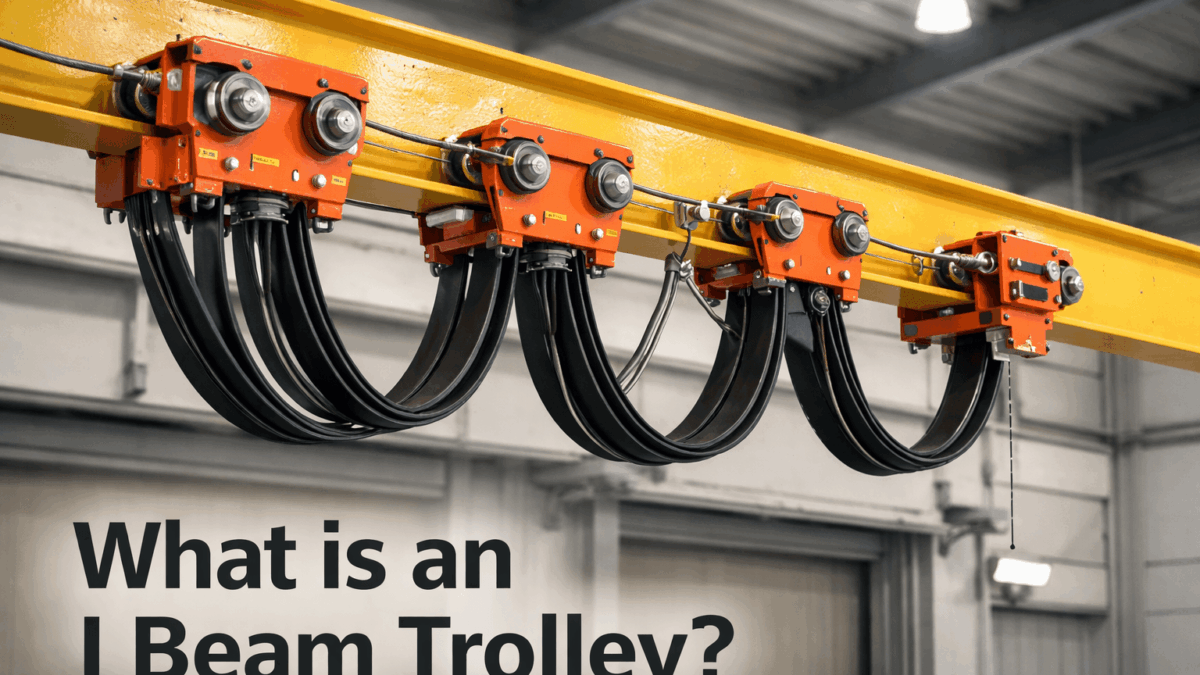
An I beam trolley is a cable carrying component that runs along an I-beam track to support and guide moving power or control cables in industrial systems. It is commonly used in festoon systems, overhead crane setups, and other mobile equipment where cables need to move safely together with the machine. Instead of allowing cables to hang loosely or drag, an I beam trolley system helps organise cable movement, reduce wear, and improve operational reliability.
In many industrial environments, moving equipment needs a dependable way to carry electrical cables across a travelling path. This is where an I beam trolley becomes important. It allows the cable package to move in a controlled manner along the beam while supporting repeated travel, changing loads, and demanding operating conditions.
TL;DR
An I beam trolley is a moving cable support system used on an I-beam track. It helps carry and guide flat or round cables for cranes, hoists, material handling systems, and other travelling equipment. A typical system includes towing trolley, middle trolley, end trolley, and cable support components. It is widely used in factories, warehouses, workshops, steel plants, infrastructure projects, and other industrial environments where safe cable movement and long-term reliability matter.
What Is an I Beam Trolley?
An I beam trolley is part of a travelling cable management arrangement designed to operate on an I-beam. Its main purpose is to support moving cables while allowing them to travel smoothly with the connected equipment. In many cases, it forms part of a festoon system that supplies power or control signals to a moving crane, hoist, transfer unit, or machine.
The system is usually arranged so that several trolleys move together along the beam. As the machine travels, the cable loops open and close in a controlled pattern. This helps prevent unnecessary cable twisting, dragging, snagging, or premature damage.
For industrial buyers and engineers, the value of an I beam trolley system is not only movement. It is also about cable protection, safer routing, better operational consistency, and reduced maintenance risk over time.
Main Components of an I Beam Trolley System
A standard I beam trolley system may include several connected parts working together as one cable management system.
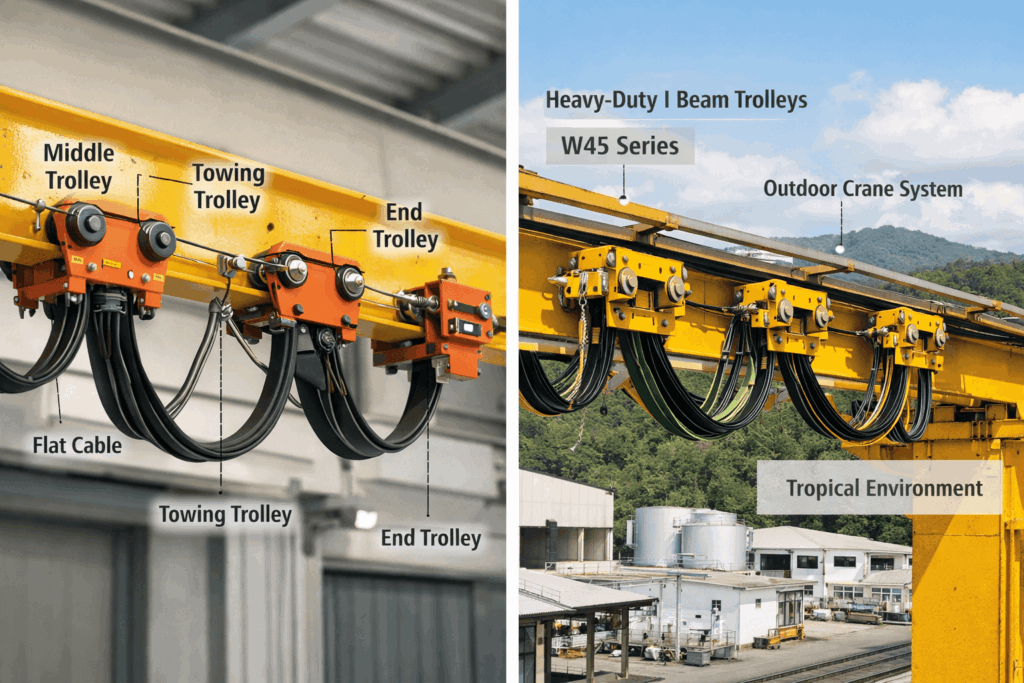
1. Towing Trolley
The towing trolley is the leading moving point in the system. It is typically connected to the moving machine or towing arm and pulls the rest of the cable trolley assembly along the beam track.
2. Middle Trolley
Middle trolleys carry the cable load between the towing end and the fixed end. These trolleys help form the cable loop arrangement and keep spacing more controlled during travel.
3. End Trolley
The end trolley is positioned at the termination side of the travelling cable path. It helps complete the system layout and supports proper cable positioning at the fixed end.
4. I-Beam Track
The I-beam acts as the running track for the trolley wheels. The beam size, straightness, and installation quality affect how smoothly the trolleys travel during operation.
5. Cable Support Elements
The system may support flat cable, round cable, or related cable packages depending on the application. The cable type, size, weight, and bending requirements all influence the trolley design and spacing.
How Does an I Beam Trolley Work?
An I beam trolley works by allowing cable carriers to move along a steel beam together with the connected machine. When the equipment travels in one direction, the trolleys roll along the beam and the cable loops extend. When the equipment returns, the trolleys move back and the cable loops gather again in a controlled way.
This movement may look simple, but proper performance depends on several engineering factors. The system needs suitable trolley spacing, correct cable support, appropriate load capacity, and a beam track that allows smooth travel. If one part is not matched properly, the cables may swing too much, wear too quickly, or move unevenly.
A well-designed I beam trolley system helps achieve:
- More organised cable travel
- Reduced cable dragging and abrasion
- Smoother machine movement
- Better protection of power and control lines
- Lower long-term maintenance risk
Why Is Proper Cable Management Important?
In industrial environments, cable movement is often repeated many times every day. Without proper cable management, cables may be exposed to bending stress, impact, friction, misalignment, or accidental snagging. Over time, these issues can contribute to downtime, unstable equipment performance, and higher replacement costs.
An I beam trolley system helps improve cable handling by keeping the cable route more predictable. This is especially useful in applications where cranes, hoists, or transfer units move continuously across the same travel path.
Where Is an I Beam Trolley Used?
I beam trolley systems are used wherever moving equipment requires reliable cable support on a fixed travel path. They are commonly found in applications that combine repeated motion, electrical supply, and industrial operating conditions.
Overhead Cranes
One of the most common uses is in overhead crane systems. The trolley assembly helps carry and manage cables as the crane or associated equipment travels along the beam.
Hoists and Lifting Equipment
I beam trolley systems are also suitable for hoists and lifting devices that require moving power or control cables in a clean and controlled layout.
Material Handling Systems
Factories and production lines often use moving equipment for transfer, handling, or positioning tasks. In these situations, the trolley system helps maintain cable order while supporting repeated travel.
Workshop and Assembly Areas
In workshops and industrial bays, cable trolleys may be used to support mobile equipment operating along a fixed line, especially where floor cable exposure should be minimised.
Heavy-Duty Industrial Machinery
In more demanding applications, a suitably selected I beam trolley system can support heavier cable loads, more intensive travel cycles, and harsher operating environments.
Which Industries Need an I Beam Trolley?
An I beam trolley is relevant to many industries that rely on lifting systems, moving equipment, or industrial cable management.
Manufacturing
Manufacturing plants often use crane systems, transfer equipment, and production support machinery that require controlled cable travel.
Warehouse and Logistics
Warehousing and logistics environments may use trolley systems for material movement, loading operations, and overhead handling applications.
Steel and Metal Processing
Steel plants and metal processing facilities usually operate in tougher conditions where durable cable support systems are important for long-term operation.
Automotive and Engineering Facilities
Engineering plants and automotive production environments may require cable management systems for repetitive movement and equipment reliability.
Ports, Infrastructure, and Heavy Industry
Projects involving large structures, transfer systems, or industrial handling equipment often need organised travelling cable systems that can perform consistently under demanding use.
General Industrial Buildings in Malaysia
In Malaysia, I beam trolley systems can be relevant across factories, workshops, warehouses, fabrication sites, and industrial facilities where overhead equipment and moving cable systems are part of daily operations.
What Should Buyers and Engineers Check Before Choosing an I Beam Trolley?
Not every I beam trolley system is the same. Selection should be based on actual operating conditions instead of appearance alone.
Important points to review include:
- Type of cable used
- Total cable load
- Travel length and travel frequency
- I-beam size and compatibility
- Indoor or outdoor operating condition
- Temperature range
- Light-duty or heavy-duty requirement
- Expected reliability and maintenance standard
A trolley system that is too light for the application may wear faster or perform inconsistently. A system that is correctly matched to the operating load and environment will usually provide smoother travel and better cable protection over time.
Quality and Safety Considerations
When evaluating an I beam trolley system, quality should not be judged only by upfront cost. In cable management applications, the long-term effect of poor movement, weak components, or incorrect system matching can be much more expensive than the original purchase price.
Quality and safety considerations may include:
- Stable trolley movement on the beam
- Suitable wheel and body construction
- Proper support for the intended cable type
- Durability under repeated travel cycles
- Resistance to the actual operating environment
- Reduced risk of cable damage and unplanned stoppage
For industrial users, a dependable system supports safer operation, cleaner cable routing, and more predictable performance throughout the equipment lifecycle.
Is an I Beam Trolley the Same as a Festoon System?
An I beam trolley is often part of a festoon system, but the two terms are not always exactly the same. The trolley refers to the moving carrier components that run on the beam. The festoon system usually refers to the wider travelling cable arrangement that includes the beam track, trolley assembly, cable loops, towing point, and fixed end configuration.
In practice, many industrial users discuss them together because the trolley is one of the key working parts of the full cable management system.
Conclusion
An I beam trolley is an important industrial cable management solution used to support moving power and control cables along an I-beam track. It helps equipment move more smoothly while protecting cables from unnecessary wear, poor routing, and operational risk.
From overhead cranes and hoists to material handling systems and heavy-duty industrial applications, I beam trolley systems are widely used where organised cable travel is necessary. For buyers, engineers, and project teams, understanding how the system works is the first step toward choosing the right solution for performance, safety, and long-term reliability.
If your application involves moving equipment and travelling cables, an I beam trolley system is not just a hardware component. It is a practical part of maintaining stable industrial operation.
(FAQ)
What is an I beam trolley used for?
An I beam trolley is used to support and guide moving cables along an I-beam track. It is commonly applied in crane systems, hoists, and other industrial equipment that need controlled cable movement.
How does an I beam trolley work?
It works by allowing trolley units to roll along an I-beam as the connected machine moves. This creates an organised cable loop movement that helps protect the cables and maintain smoother travel.
Where is an I beam trolley commonly used?
I beam trolley systems are commonly used in overhead cranes, material handling systems, workshops, factories, warehouses, and other industrial environments with moving equipment.
What industries use I beam trolley systems?
Industries such as manufacturing, steel processing, logistics, engineering, infrastructure, and heavy industry often use I beam trolley systems where reliable cable management is required.
Is an I beam trolley part of a festoon system?
Yes. In many applications, the I beam trolley is one of the main moving components within a festoon system. It helps carry the cable package along the beam track.
What should I check before selecting an I beam trolley?
You should review cable type, cable load, beam size, travel distance, travel frequency, environmental condition, and the required duty level before choosing a suitable system.
Why is cable management important in moving industrial equipment?
Proper cable management helps reduce cable wear, improve safety, support smoother equipment travel, and lower the risk of maintenance issues caused by loose or poorly controlled cables.