
How to Choose an I-Beam Trolley for Cable and Hose Support Systems
April 14, 2026
Festoon System Components Explained for Industrial Cable Management
April 22, 2026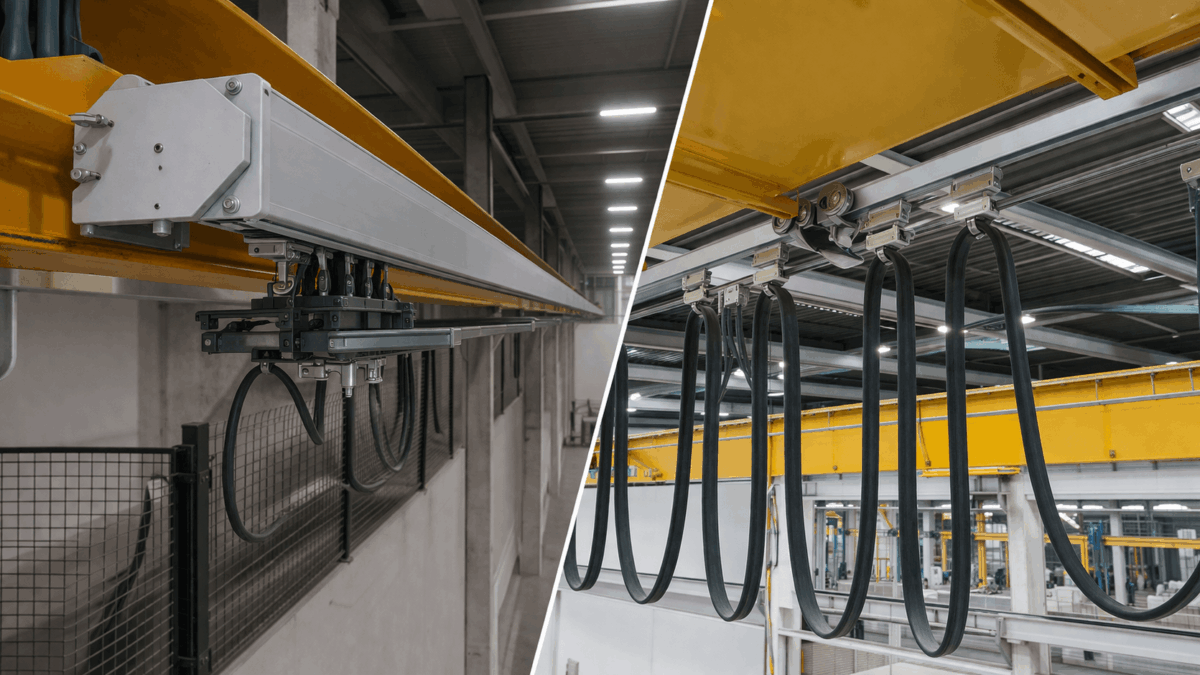
In crane and material handling systems, selecting the right power supply arrangement is important for long-term performance, maintenance planning, and operating reliability. Two commonly used options are the enclosed busbar system and the festoon system. Each serves a different technical approach to supporting crane electrification, and each may be more suitable depending on the application.
For engineers, consultants, and project teams, the key question is not simply which system is more popular, but which one is better matched to the movement pattern, environment, maintenance requirements, and overall operating conditions of the crane installation.
Why This Comparison Matters in Crane Electrification
Crane electrification systems must provide dependable power to moving equipment while supporting safe and stable operation. A poorly matched system may lead to higher maintenance, more wear, or reduced operating efficiency over time.
This is why understanding the difference between an enclosed busbar system and a festoon system is important when evaluating crane power supply options. Although both can be used in industrial crane environments, they are based on different operating principles and are not always interchangeable.
What Is an Enclosed Busbar System?
An enclosed busbar system is a conductor rail-based power supply arrangement designed to deliver electrical power to moving equipment through insulated conductors housed inside a protective enclosure. Current collectors move along the busbar and transfer power to the crane or travelling machine.
This system is often selected for applications where a compact and organised power supply solution is preferred. Because the conductors are enclosed, the design can help support a cleaner and more structured electrification setup compared with hanging cable arrangements in certain industrial environments.
What Is a Festoon System?
A festoon system is a cable management arrangement that supports moving cables or hoses through a series of trolleys running on a track. As the crane or travelling equipment moves, the trolleys carry suspended cable loops in an orderly manner.
In crane applications, a festoon system is widely used because it is practical, visible for inspection, and suitable for many straight-travel cable management requirements. It is commonly applied where flexibility and straightforward support of power or control cables are needed.
Main Difference Between Enclosed Busbar and Festoon System
The main difference is the way electrical power is delivered to the moving crane.
- An enclosed busbar system uses enclosed conductor rails with current collectors.
- A festoon system uses moving cables suspended in loops and supported by travelling trolleys.
This difference affects installation style, maintenance approach, space use, exposure of moving components, and suitability for different environments.
How Enclosed Busbar Systems Support Crane Electrification
Enclosed busbar systems are often used where a more compact and continuous power supply arrangement is preferred. Because the conductors are installed within a protective housing, the system may provide a cleaner layout for certain overhead crane and long-travel applications.
In some industrial environments, this type of design helps reduce loose cable management concerns and supports a more structured electrification path. For this reason, many engineers consider an enclosed busbar system where long travel, frequent movement, or organised conductor protection are important considerations.
How Festoon Systems Support Crane Electrification
Festoon systems support crane electrification by managing flexible power and control cables during repeated movement. The cables are suspended between trolley points, allowing them to move with the crane while remaining supported and visible.
This type of system is often selected where cable-based support is suitable, where application conditions are straightforward, or where maintenance teams prefer easily visible cable routing and component access. A festoon system can also be practical where the crane design or system requirement involves both power and control cable movement together.
Installation Considerations
Enclosed Busbar System
Installation typically involves mounting conductor rail sections, alignment of the enclosed track, and integration of collector assemblies with the moving equipment. Precision in installation is important because collector movement and contact reliability depend on proper system setup.
Festoon System
Installation generally involves track mounting, trolley arrangement, cable loop planning, and proper support spacing. The mechanical layout must be designed carefully so cables move smoothly without excessive bending, snagging, or drag.
In both cases, installation quality affects long-term performance. The decision should be based on application suitability rather than assuming one system is always simpler than the other.
Maintenance Considerations
Maintenance requirements differ because the system designs are different.
Enclosed Busbar System Maintenance
Maintenance may focus on conductor condition, collector wear, alignment, and continuity of power transfer. Because the conductors are enclosed, the system may appear cleaner and more protected in some operating environments, but component inspection still remains important.
Festoon System Maintenance
Maintenance may focus on cable condition, trolley movement, track alignment, cable support points, and loop integrity. Since the cables are exposed and visible, wear issues may be easier to identify during visual inspection.
The better choice depends on how the site operates, how maintenance is planned, and what type of access is available during service work.
Environmental Suitability
Environmental conditions play an important role in selecting between these two crane electrification options.
An enclosed busbar system may be considered where a more protected conductor arrangement is preferred, especially when a compact and organised power supply layout is beneficial.
A festoon system may be suitable where cable visibility, straightforward movement support, and practical access for inspection are important. Environmental exposure, dust, humidity, and movement conditions should all be reviewed before final selection.
When Enclosed Busbar Systems May Be More Suitable
An enclosed busbar system may be more suitable when:
- the application benefits from a compact conductor rail design
- continuous crane travel requires an organised power path
- cable loop management is less desirable for the installation
- the project requires a more structured electrification arrangement
- the environment and operating conditions support conductor rail use
This does not mean it is always the better option. It simply means the application may align more closely with the strengths of an enclosed conductor system.
When Festoon Systems May Be More Suitable
A festoon system may be more suitable when:
- flexible cables are preferred for the movement requirement
- the application includes power and control cable support together
- maintenance teams prefer visible cable movement and easier inspection access
- the installation layout supports trolley-based cable travel
- the system design calls for a practical cable management arrangement
In many industrial crane applications, a festoon system remains a dependable solution when selected and installed according to actual operating conditions.
Neither System Should Be Chosen by Price Alone
In crane electrification, the lowest upfront cost does not always result in the best long-term outcome. The wrong system choice may increase wear, inspection needs, or service interruptions over time.
The better approach is to evaluate movement pattern, travel distance, operating environment, maintenance access, and the broader technical requirement before choosing either an enclosed busbar system or a festoon system.
How This Comparison Relates to Other Crane Power Supply Options
In some industrial installations, project teams may also consider alternatives such as a unipole system depending on the travel path, current demand, and system design requirements. The correct choice always depends on the specific technical application rather than a general preference for one product type.
Conclusion
Both enclosed busbar and festoon systems are established solutions for crane electrification, but they serve different technical approaches. An enclosed busbar system may be more suitable where a compact and structured conductor rail arrangement is preferred, while a festoon system may be more suitable where flexible cable support and visible inspection access are important.
The better choice depends on movement requirements, environment, installation design, and maintenance expectations. For engineers and buyers, the most reliable approach is to review the operating conditions carefully before finalising the crane electrification system.
FAQ
1. What is the main difference between enclosed busbar and festoon system?
The main difference is how power is delivered to the moving crane. An enclosed busbar system uses conductor rails and collectors, while a festoon system uses moving flexible cables supported by trolleys.
2. Which is better for crane electrification, enclosed busbar or festoon system?
Neither is universally better. The right choice depends on the crane design, travel pattern, environment, maintenance priorities, and overall application requirements.
3. Is an enclosed busbar system better for long-travel cranes?
In some long-travel applications, an enclosed busbar system may be preferred because it provides a compact and organised conductor rail arrangement. Final suitability depends on the full system design.
4. When is a festoon system more suitable?
A festoon system may be more suitable where flexible cable movement is required, where power and control cables need to travel together, or where visible inspection access is useful for maintenance teams.
5. Does maintenance differ between the two systems?
Yes. Enclosed busbar systems typically require review of collectors, alignment, and conductor condition, while festoon systems require review of cables, trolleys, track alignment, and loop condition.
6. Should crane electrification systems be selected based only on price?
No. The correct system should be selected based on movement requirements, operating environment, maintenance expectations, and long-term reliability rather than upfront cost alone.
Disclaimer: Every crane installation has different travel conditions, load requirements, operating environments, and maintenance priorities. For accurate system selection and technical advice, the application should be reviewed by a qualified engineering team.